Call (717) 842-9770
Call (717) 842-9770
Well Pump Services · York, PA

Well Pump Repair & Service In York, PA

No water at the tap when you're on a private well means one thing — the pump, pressure tank, or electrical supply has failed. Scott's H Plumbing diagnoses and repairs submersible and jet well pumps across York County's rural townships, 24 hours a day.

24-Hr Emergency Dispatch
Direct Answer

Scott's H Plumbing provides well pump repair and replacement in York, PA — including submersible deep well pumps, jet pumps, pressure tank service, pressure switch replacement, and well electrical troubleshooting. If you're on a private well and have lost water pressure or have no water at all, call (717) 842-9770 any time. Well pump failures are dispatched as emergencies around the clock.

No Water From Your Well Right Now?

Loss of water on a private well is always an emergency — call (717) 842-9770 immediately. Tell the dispatcher whether you have zero water or just low pressure, and whether you've heard any unusual sounds from the pump or pressure tank recently.

Call (717) 842-9770

Private Wells In York County — What's Different Out Here

A significant portion of York County sits outside the York Water Company service territory. The townships surrounding the city — Springettsbury, Manchester, Dover, Conewago, Shrewsbury, Peach Bottom, and others — rely on private wells drilled into the limestone and carbonate rock formations that underlie south-central Pennsylvania. That geology delivers hard water with high mineral content, which affects well components differently than it affects municipal plumbing. Scale accumulates on pump impellers, in the pressure tank, and on valve seats inside the well system, gradually reducing yield and efficiency in ways that aren't always obvious until the system fails outright.

York County's limestone aquifer is generally reliable in terms of yield, but drought years and the increasing demand from residential development in the townships have created drawdown situations in some areas where wells that performed well for decades have seen declining water table levels. A pump that was adequately sized for the original well yield may struggle as the static water level drops — showing up as low pressure, sputtering, or air-in-the-line symptoms that look like pump failure but are actually a well yield issue. Diagnosing which it is before pulling the pump matters, because the repairs are entirely different.

What We Service

Well Pump & Pressure System Services

Submersible Well Pump Repair & Replacement

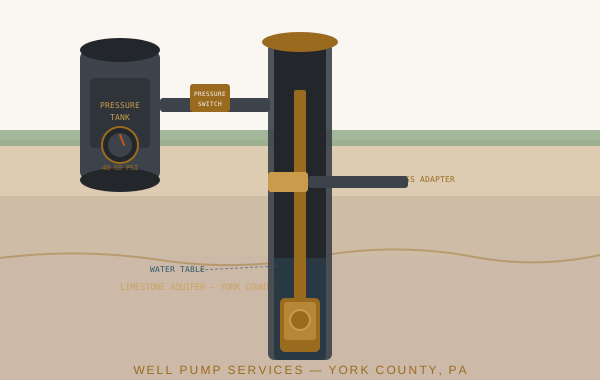
Submersible pumps sit at the bottom of the well casing and are the most common type in York County's deeper private wells. When a submersible fails — whether from motor burnout, impeller wear, or broken drop pipe — the pump must be pulled from the well. We carry common pump sizes on the truck for same-day replacement in most residential applications.

Jet Pump Service

Shallow jet pumps and deep jet pump systems used in older York County installations are diagnosed and repaired above ground. Common issues include loss of prime, worn impellers, failed injector assemblies, and foot valve failures at the well intake.

Pressure Tank Replacement

A waterlogged pressure tank — one where the bladder or diaphragm has failed and the tank holds water instead of a compressed air charge — causes the pump to short-cycle, running every few seconds instead of in normal intervals. Short-cycling burns out pump motors faster than almost any other failure mode. Pressure tank replacement stops the damage before the pump itself fails.

Pressure Switch Replacement & Calibration

The pressure switch controls when the pump starts and stops. A switch with incorrect cut-in and cut-out settings, failing contacts, or a clogged port from mineral scale causes erratic pressure, pump cycling problems, or a pump that won't start at all despite being electrically sound.

Well Electrical Troubleshooting

Control boxes, start capacitors, run capacitors, and wiring between the panel and the well are common failure points that don't require pulling the pump to repair. We test electrically first before any pump pull — a motor that won't start is often a failed capacitor rather than a failed pump.

Low Pressure & Yield Diagnosis

Low pressure that's been getting worse over months is a different problem from sudden total water loss. Gradual decline can indicate pump impeller wear, a partially failing pressure tank, scale buildup reducing pipe diameter, or declining well yield. We distinguish between them before recommending any repair.

Common Symptoms

What Different Well Problems Feel Like

  1. 1
    No Water At All

    Complete loss of water on a private well is most often a pump failure, a tripped breaker, a blown fuse at the well control box, or a failed pressure switch. Check the breaker first — if it's not tripped, call us. A breaker that trips immediately when reset indicates an electrical fault that requires diagnosis before anything else.

  2. 2
    Pump Runs Constantly

    A pump that never shuts off means it cannot build enough pressure to reach the cut-out setting on the pressure switch. Causes include a serious leak in the distribution system, a failed pressure tank bladder, a worn pump that can no longer make adequate pressure, or a pressure switch set too high for the pump's capacity.

  3. 3
    Pump Short-Cycles (Starts Every Few Seconds)

    Rapid on-off cycling almost always means a waterlogged pressure tank. The tank has lost its air charge and can't store enough pressurized water to carry the system between pump cycles. The pump runs itself to death trying to compensate. This needs prompt attention to avoid premature pump motor burnout.

  4. 4
    Sputtering Or Air In The Water

    Air coming through fixtures when the pump is running suggests the pump intake is drawing air — either because the water table has dropped below the pump intake depth, or because the drop pipe or pitless adapter has developed a leak above the water line. Both require pulling the pump to diagnose definitively.

  5. 5
    Gradually Declining Pressure Over Months

    Slow pressure decline without sudden changes points to pump impeller wear from mineral scale or sediment, a pressure tank bladder that's slowly losing its air charge, or well yield reduction in drought conditions. A pressure test and system check narrows it down before any expensive repair is authorized.

  6. 6
    Discolored Or Sediment-Laden Water

    Brown or gritty water from a well that previously ran clear can indicate pump intake screen failure, disturbed well sediment from a pump problem, or a casing issue allowing surface intrusion. This is a water quality concern that should be addressed promptly.

Frequently Asked Questions

Well Pump Questions For York County Homeowners

Most submersible well pumps last ten to fifteen years under normal conditions. In York County's hard water, scale buildup on impellers and motors can shorten that range, particularly in wells that haven't had any maintenance. A pump that's being asked to run more frequently due to a waterlogged pressure tank will also wear out significantly faster than one operating in normal cycling conditions.

Some components — the control box, capacitors, pressure switch, and wiring — can be serviced above ground. But the pump motor and impeller assembly itself are at the bottom of the well casing, and any mechanical failure of the pump requires pulling the drop pipe to access it. We always diagnose electrically first to confirm it's actually a pump problem before pulling.

A breaker that trips on the well pump circuit almost always means the motor is drawing more current than it should — a sign of a failing motor winding, a seized bearing, or a pump working against a blockage. Do not keep resetting a breaker that trips repeatedly on a pump circuit; the overcurrent condition is protecting the motor from a worse failure, and repeated resets can destroy a motor that might otherwise be repairable.

A pitless adapter is the fitting that passes through the well casing wall below the frost line, connecting the drop pipe inside the well to the horizontal supply line running to the house. It can corrode or work loose over decades, creating a leak path that allows air into the system or — in severe cases — surface water contamination into the well. Sputtering water or declining yield in a well with an older pitless adapter is worth investigating at that connection point.

Yes. The limestone geology that makes York County's groundwater so hard also means the water carries dissolved minerals that accumulate on pump impellers, inside pressure tanks, and on pressure switch ports over time. A pressure switch port clogged with mineral scale reads artificially high pressure and causes the pump to underperform or cycle incorrectly. Annual system checks catch this before it causes premature pump failure.

A well yield problem and a pump problem can look identical from inside the house. The distinction requires measuring static water level in the well and comparing it to the pump intake depth, along with a pump performance test. We do both before recommending a pump replacement — if the yield has declined, replacing the pump with an identical unit won't fix the pressure problem.

Well Pump Emergency Or Scheduled Service

Private well failures don't wait for business hours, and neither do we. One number handles everything: (717) 842-9770 — dispatched 24 hours a day across York County.

Call (717) 842-9770
CALL NOW — (717) 842-9770